
Learn how to maintain control as a software architect in the age of coding agents.
🔎 Discover our new training: Architecture in the Context of Agentic Development.
socreatory training

Spring Modulith

Basics
2 Days
12
Seats
German and English
Online and in-person
Available on request

Also available as in-house training

We run this training exclusively for your team, online or on site.
In-house Offerings

Objectives

  • You can classify the idea behind moduliths and how they differ from microservices.
  • You will define and structure modules with Spring Modulith.
  • Implement suitable communication patterns between modules (synchronous, asynchronous, events).
  • You can automatically check architecture rules and integrate them into CI/CD pipelines.
  • You can independently design and extend a modular sample application.

Curriculum

Basics

  • Motivation & Classification
  • Modularity Comparison: Modulith vs. Microservices
  • Evolutionary Architecture
  • Project Setup & Module Definition
  • Package Structures & Module Detection
  • Simple, Advanced, Nested, Open Modules
    • Named Interfaces
  • Custom Module Detection

Non-Runtime Support

  • Architecture Checking
  • Dependency Rules & Architecture Tests
  • ArchUnit Integration
  • Customizing Verification Options
  • Fundamentals of Module Testing
    • Application Module Testing Support
  • Handling dependencies
  • Bootstrap modes
  • Change-aware test execution
  • Documentation
  • Modulith diagrams (C4, UML)
  • Application module canvas

Runtime support

  • Communication between modules
  • Domain events – synchronous & asynchronous
  • Event publication registry (persistence, repetition, completion modes)
  • Staleness checks
  • Impact on integration tests
  • Scenario API for event-driven integration tests
    • PublishedEvents & AssertablePublishedEvents
  • Passage of Time Events with Moments API
  • Integration into the development process
  • CI/CD & Fitness Functions
  • Runtime Support: ApplicationModuleInitializer
  • Production-Ready Features:
  • Modulith Actuator Endpoint /actuator/modulith - Observability (Micrometer, tracing with OpenTelemetry, Zipkin, etc.)
  • Module-specific Flyway migrations
  • Configurable Modulith properties (e.g., staleness checks)

Misc

  • jMolecules – Making DDD concepts explicit (optional)
  • Aggregates, entities, value objects
  • Domain events & event handlers
  • Repositories
  • Module annotation
  • Use in Modulith documentation & canvas
  • ArchUnit integration for DDD and architecture rules
  • Outlook & discussion
    • Migration of legacy applications to Modulith
  • Hybrid architectures (Modulith + microservices)
  • Event externalization (Kafka, AMQP, JMS, Spring Messaging)
  • Best practices for DDD with jMolecules
  • Experiences & lessons learned

Audience

  • Software developers who work with Spring Boot and want to structure their applications in a clearly modular way.
  • Software architects who want to critically examine microservices or design hybrid architectures.
  • Teams that want to modernize existing monoliths and gradually convert them into modular systems.

Description

Get a practical overview of Spring Modulith. This is a modern approach to structuring applications in a modular way without having to deal with the complexity of distributed architecture approaches.

‍

Microservices are often considered the ideal solution for modularization – but they come with significant technical and organizational challenges. Moduliths offer a pragmatic alternative: a modular monolith that clearly structures technical aspects and remains maintainable in the long term.

‍

We apply the concepts in practice using an example application. We discuss how dependencies can be controlled, architecture rules can be checked automatically, documentation can be generated, and existing systems can be modernized step by step.
Trainers

Falk Sippach

Software Architect and Consultant at embarc

Main Skills

Architecture reviews, Java expert

Patrick Baumgartner

Founder of 42talents

Main Skills

Java, Spring, Cloud

More on this topic

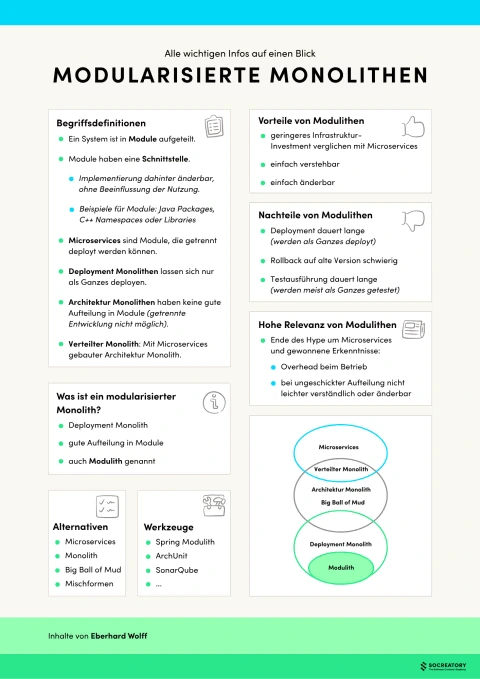
Cheat Sheet: Modular Monoliths

All information on modular monoliths is summarized in this cheat sheet.

Eberhard Wolff

In-house Training

You can also book this training as an in-house training course exclusively for your team. Please use the enquiry form for more details.

Enquire now

You may also like

socreatory training

Spring Security in practice

Basics
Advanved
2 Days
12
seats
German and English
Online and In-person
Custom Quote
socreatory training

Spring Data JPA Masterclass

Basics
Advanved
1-3 Days
12
seats
German and English
Online and In-person
Custom Quote
socreatory training

Spring Boot Essentials

Basics
Advanved
4 Days
12
seats
German and English
Online and In-person
Custom Quote
socreatory training
New

Legacy Modernization with DDD and Spring Boot

Basics
Advanved
3 Days
12
seats
German and English
Online and In-person
Custom Quote

Frequently Asked Questions

What is the maximum number of participants in a training session?

For most training sessions, we limit the maximum number of participants to 12 per instructor. This allows us to ensure that you receive the best possible guidance.

Are meals provided during in-person training sessions?

Of course, we’ll take care of your meals during our in-person training sessions. We usually provide snacks twice a day and lunch. Drinks are also available.

Where can I find information about the training session I've already booked?

You can find all the information about your training in our socreatory Navigator. Here, in addition to useful links and information, you’ll find the specific location of the training for in-person sessions and the link to the video call for online sessions.

When and how will I receive my certificate of attendance after the training?

If you have attended at least 75% of the sessions, you will receive a certificate of attendance from us. You can download it from our socreatory Navigator a few days after the training.

Why socreatory?

Beyond the expertise of our trainers and our wide range of training courses, we offer even more compelling reasons to train with us.

All the benefits at your fingertips – download our program overview!

Unique Variety

We offer you the most comprehensive training program for software architecture in the German-speaking region – accredited and certified by iSAQB®.

Powerful IT expertise

Our experienced trainers are renowned experts in the industry and have co-developed 80 percent of the module curricula, both in terms of content and teaching methodology.

Hands-on learning experience

We are committed to providing interactive and engaging learning experiences, ensuring all participants can directly apply what they've learned.

Fair pricing model

The total price is reduced for as few as two participants from your company. Furthermore, you benefit from early bird pricing and enhanced planning certainty.

Looking for team training?

Unlock your team's potential with our specialized software architecture courses. We offer a variety of options, from in-depth iSAQB® training to customized workshops tailored precisely to your company's needs. Discover how these training programs can enhance your team's skills, and take advantage of attractive group and package discounts to maximize the value of your investment.