
Learn how to maintain control as a software architect in the age of coding agents.
šŸ”Ž Discover our new training: Architecture in the Context of Agentic Development.
socreatory training

Apache Maven Masterclass

Basics
3 days
12
Seats
German and English
Online and in-person
From
2026-12-14

Also available as in-house training

We run this training exclusively for your team, online or on site.
In-house Offerings

Objectives

  • You want to know how it works under the hood.
  • You are dissatisfied with your build and want to learn about optimization options.
  • Here you will learn which tasks Maven is well suited for and which it is not.
  • You have complex testing and quality assurance processes and want to improve them.
  • Learn about and appreciate the advantages of the optionated Maven build in terms of comprehensibility and maintainability, especially if other build tools seem easier at first glance.

Curriculum

Day 1 and 2

  • What distinguishes Maven from Ant and Gradle?
  • What should you avoid doing with Maven (and what alternatives are there)?
  • Developer experience when using Maven
    • Installation (central vs. project-specific, aka Maven Wrapper)
    • Execution
    • Integration with IDE using IntelliJ IDEA as an example
  • How does Maven work under the hood?
    • Definition of terms: plugin, extension, dependency, POM, lifecycle
    • Initial concepts: build lifecycle (default)
  • Simple project organization
    • Convention over configuration
    • Source code organization
    • Your minimal POM
    • Packaging - Lifecycle mapping
    • Principle of the super POM (convention)
    • If the convention does not fit exactly, then specify it (properties)
    • Why should you not (initially) disregard the convention?
  • Dependency Management
    • GAV - Coordinates in conjunction with a Maven repository
    • Maven Central
    • How to find your dependencies (web search and ā€˜mcs’)?
    • Scopes
    • Transitive dependencies
    • How does Maven build the classpath based on dependencies?
    • What impact does this have on the class loader?
    • Dependency management (BOM, troubleshooting in the dependency jungle)
  • Maven plugins
    • Concept deep dive
    • Interaction with lifecycle
    • Default plugins from the lifecycle and packaging
    • Plugins vs. plugin management
    • Typical use cases and corresponding plugins (overview)
    • Plugins for testing and quality assurance of the project
    • Direct code analysis (PMD, spotbug)
    • Code style
    • Technical test execution and integration tests including coverage (JaCoCo)
    • Quality assurance for the build setup
    • Troubleshooting in the build process
  • More complex project structures
    • Multi-module projects
    • Build: Parent POM vs Reactor POM
  • How can shared dependencies be managed?
    • Dependencies: Parent POM and dependency management
    • Dependency management as a bill of materials (BOM)
    • Creating your own BOM (multiple scenarios)
    • Building and consuming your own artifacts (snapshot vs. release)
  • Management and publication of build artifacts in the corporate environment
    • Release process
    • Maven profiles
    • Your own snapshot repository
    • Mirroring of Maven Central and other global repositories
    • Security aspects of external Maven artifacts

Day 3

  • Continuous integration with Maven
    • Parallel builds and branching
    • (Remote) caching and other ways to speed up the build
    • Publishing SNAPSHOTs
    • Project versioning
    • Continuous delivery and deployment
    • Building and testing with containers
    • Best practices for widely used build servers (Jenkins, GitHub Actions, GitLab CI, etc.)
  • When Maven can’t do something (well)
    • Start external programs
    • Run scripts
    • Use extensions
    • Create your own plugins and, if necessary, extensions
  • Monitor and evaluate quality over time
    • Code analysis and test coverage: SonarQube
    • Security
    • Runtime measurements (how long does my build take)
    • Load and performance tests of the project
  • Maven 4 - New features
    • Build POM vs. Consumer POM
    • New wording
    • Automating upgrades
    • BOMs as packaging
    • Optimizations in dependency management
    • Building newer JDKs (>= 17) as Maven runtime while still building ā€œoldā€ projects

Audience

Are you working on a Java project whose build process goes beyond compile, test, and install?Do you have basic experience with build tools and want to take your knowledge to the next level?Then you’ve come to the right place!

This training is aimed at roles such as

  • Developers
  • DevOps engineers
  • Platform engineers
  • Test engineers
  • Software architects

Technical requirements:

  • Your own computer with at least JDK 17, Apache Maven 3.9.x or higher (but not yet Maven 4.x) preinstalled, and an IDE you are familiar with
  • Internet access, especially to Maven Central and GitHub
  • Docker or another container runtime is recommended.

Description

This training course provides you with a comprehensive overview of Apache Mavenā„¢ – practical and tailored to your needs. The choice is yours:
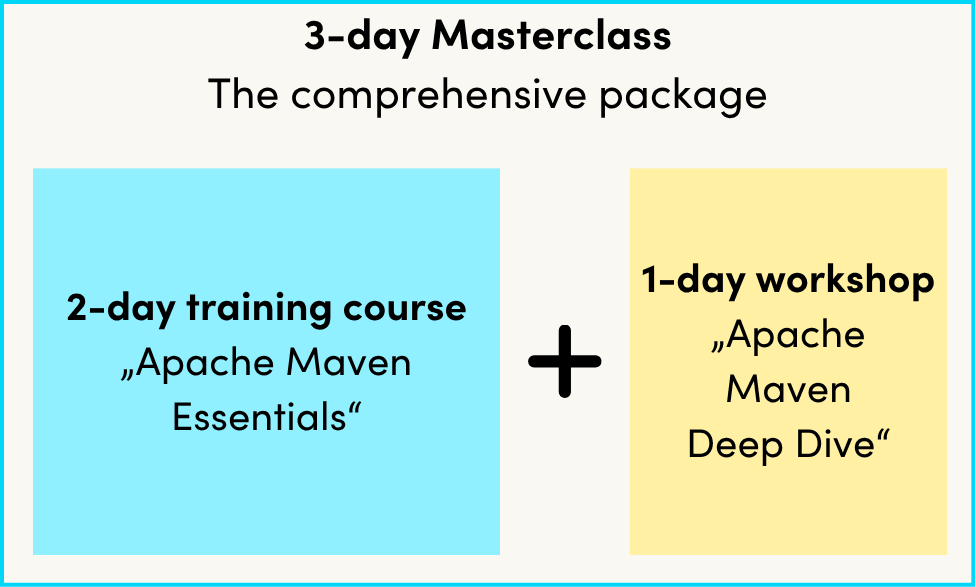
  • 3-day masterclass for a comprehensive overall package
  • 2-day training course ā€œApache Maven Essentialsā€ to understand and apply all the important concepts
  • 1-day workshop ā€œApache Maven Deep Dive,ā€ which builds on the essentials and delves deeper into selected topics.

ā€

ā€

A well-designed build process works smoothly on the command line, in the IDE, and in CI automation. It is understandable, traceable, extensible, reproducible, reliable, and maintainable—and that is exactly what you will learn to implement in this training with Apache Maven.

ā€

Deepen your understanding of the central concepts and their implementation. Practical exercises help you apply what you have learned directly in your everyday work and improve your build processes in the long term.

Trainers

Sandra Parsick

Freelance Software Developer and Consultant

Main Skills

Java Enterprise, cloud technologies, Maven
More on this topic

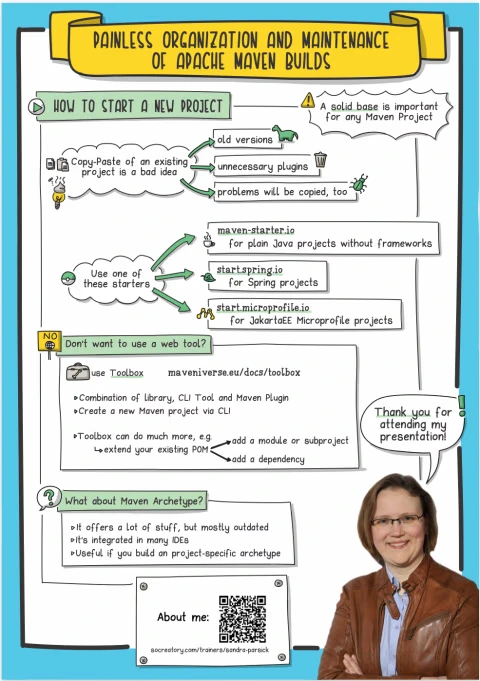
Cheat Sheet: Organization and Maintenance of Apache Maven Builds

See at a glance which tools and tricks can help you organize your Apache Maven builds and make maintenance easier.

Sandra Parsick

Online Courses

In-house Training

You can also book this training as an in-house training course exclusively for your team. Please use the enquiry form for more details.

Enquire now

Frequently Asked Questions

What is the maximum number of participants in a training session?

For most training sessions, we limit the maximum number of participants to 12 per instructor. This allows us to ensure that you receive the best possible guidance.

Are meals provided during in-person training sessions?

Of course, we’ll take care of your meals during our in-person training sessions. We usually provide snacks twice a day and lunch. Drinks are also available.

Where can I find information about the training session I've already booked?

You can find all the information about your training in our socreatory Navigator. Here, in addition to useful links and information, you’ll find the specific location of the training for in-person sessions and the link to the video call for online sessions.

When and how will I receive my certificate of attendance after the training?

If you have attended at least 75% of the sessions, you will receive a certificate of attendance from us. You can download it from our socreatory Navigator a few days after the training.

Why socreatory?

Beyond the expertise of our trainers and our wide range of training courses, we offer even more compelling reasons to train with us.

All the benefits at your fingertips – download our program overview!

Unique Variety

We offer you the most comprehensive training program for software architecture in the German-speaking region – accredited and certified by iSAQBĀ®.

Powerful IT expertise

Our experienced trainers are renowned experts in the industry and have co-developed 80 percent of the module curricula, both in terms of content and teaching methodology.

Hands-on learning experience

We are committed to providing interactive and engaging learning experiences, ensuring all participants can directly apply what they've learned.

Fair pricing model

The total price is reduced for as few as two participants from your company. Furthermore, you benefit from early bird pricing and enhanced planning certainty.

Looking for team training?

Unlock your team's potential with our specialized software architecture courses. We offer a variety of options, from in-depth iSAQBĀ® training to customized workshops tailored precisely to your company's needs. Discover how these training programs can enhance your team's skills, and take advantage of attractive group and package discounts to maximize the value of your investment.